
Free AI summary of this YouTube video by SumTube
화학1 p172 식초속아세트산함량 실험영상
TL;DR
This educational video demonstrates a laboratory neutralization titration experiment to determine the acetic acid concentration in commercial vinegar. It guides viewers through preparing diluted vinegar samples, titrating with sodium hydroxide using a phenolphthalein indicator, and calculating the molarity and total amount of acetic acid.

Key takeaways
- 0:19Vinegar must be diluted 10-fold first to enable accurate volumetric measurement and titration
- 2:31Phenolphthalein serves as the indicator, turning the solution permanently pink at the neutralization endpoint
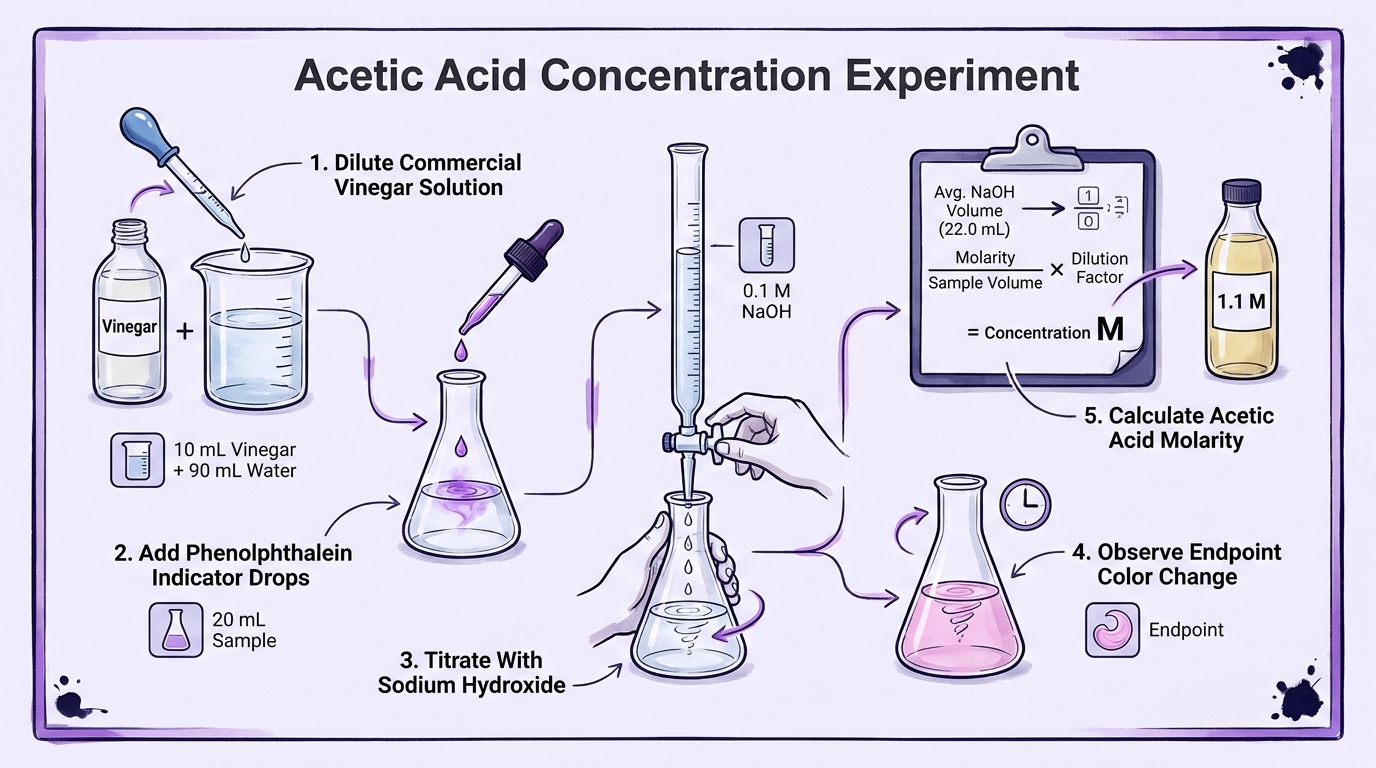
- 3:49By applying the 1:1 molar neutralization ratio, the original vinegar concentration is calculated to be 1.1 M.
Tap to enlarge
Most valuable section
For whom
Chemistry students and educators looking for a clear, step-by-step visual demonstration of an acid-base neutralization titration.
Titration Process and Endpoint2:07
It shows the precise procedure for adding NaOH from the burette and swirling the flask until the distinct pink color change marks the exact equivalence point.
Detailed summary
1. Introduction and Preparation
0:00The experiment begins with an overview of the objective: determining the concentration of acetic acid in commercial vinegar through neutralization titration. All necessary laboratory equipment and chemical reagents are prepared, including sodium hydroxide solution, vinegar, distilled water, phenolphthalein indicator, burette, stand, and glassware.
To begin the test, 10 mL of commercial vinegar is carefully measured with a pipette and combined with 90 mL of distilled water in a beaker. This step creates a 10-fold diluted vinegar solution, ensuring that titrant consumption remains within standard burette volume limits during the procedure.
2. Performing the Titration
0:33From the diluted vinegar mixture, 20 mL is pipetted into an Erlenmeyer flask, and 2 to 3 drops of phenolphthalein indicator are added. The initial liquid volume level of the 0.1 M NaOH solution filled in the burette is recorded accurately at 3.6 mL.
The Erlenmeyer flask is placed under the burette, and NaOH solution is gradually added dropwise while gently swirling the flask. As neutralization nears completion, a pink color appears transiently and disappears upon mixing until a permanent light pink color remains, signifying the endpoint at a burette reading of 25.8 mL.
3. Calculations and Results
3:36The titration procedure is repeated to obtain a second trial result. The average volume of 0.1 M NaOH solution consumed across both trials is calculated to be 22.0 mL. Using the 1:1 stoichiometric equation CH₃COOH + NaOH → CH₃COONa + H₂O, the concentration of the diluted acetic acid sample is determined to be 0.11 M.
Multiplying by the dilution factor of 10 reveals that the original commercial vinegar has an acetic acid concentration of 1.1 M. For a standard 500 mL bottle of vinegar, this concentration corresponds to a total of 0.55 moles of acetic acid.
Questions this video answers
Why is the vinegar diluted before performing the titration?
Commercial vinegar has a relatively high concentration of acetic acid. Diluting 10 mL of vinegar with 90 mL of distilled water reduces the concentration so that reasonable, manageable volumes of titrant (NaOH) are required to reach the endpoint precisely.
How is the end point of the neutralization reaction determined?
Phenolphthalein indicator is added to the acetic acid solution in the Erlenmeyer flask. As 0.1 M NaOH is slowly added from the burette, the solution turns pink; when the pale pink color persists throughout the solution after swirling, the endpoint is reached and the final volume reading is taken.
What are the final calculated results for the acetic acid concentration?
Based on an average consumption of 22.0 mL of 0.1 M NaOH solution for 20 mL of diluted vinegar, the diluted sample concentration is 0.11 M. Accounting for the initial 10-fold dilution, the original vinegar molarity is 1.1 M, corresponding to 0.55 mol of acetic acid in a standard 500 mL bottle.
Ask a follow-up Premium
About this summary
SumTube AI wrote this recap from the video's words and chapters. Credit and the original belong to 켐티의 과학실.