
Free AI summary of this YouTube video by SumTube
دراسة جدوي مبادرة مزرعتك في مصر محاصيل استراتيجية م أسعد الفقي 01090855418
TL;DR
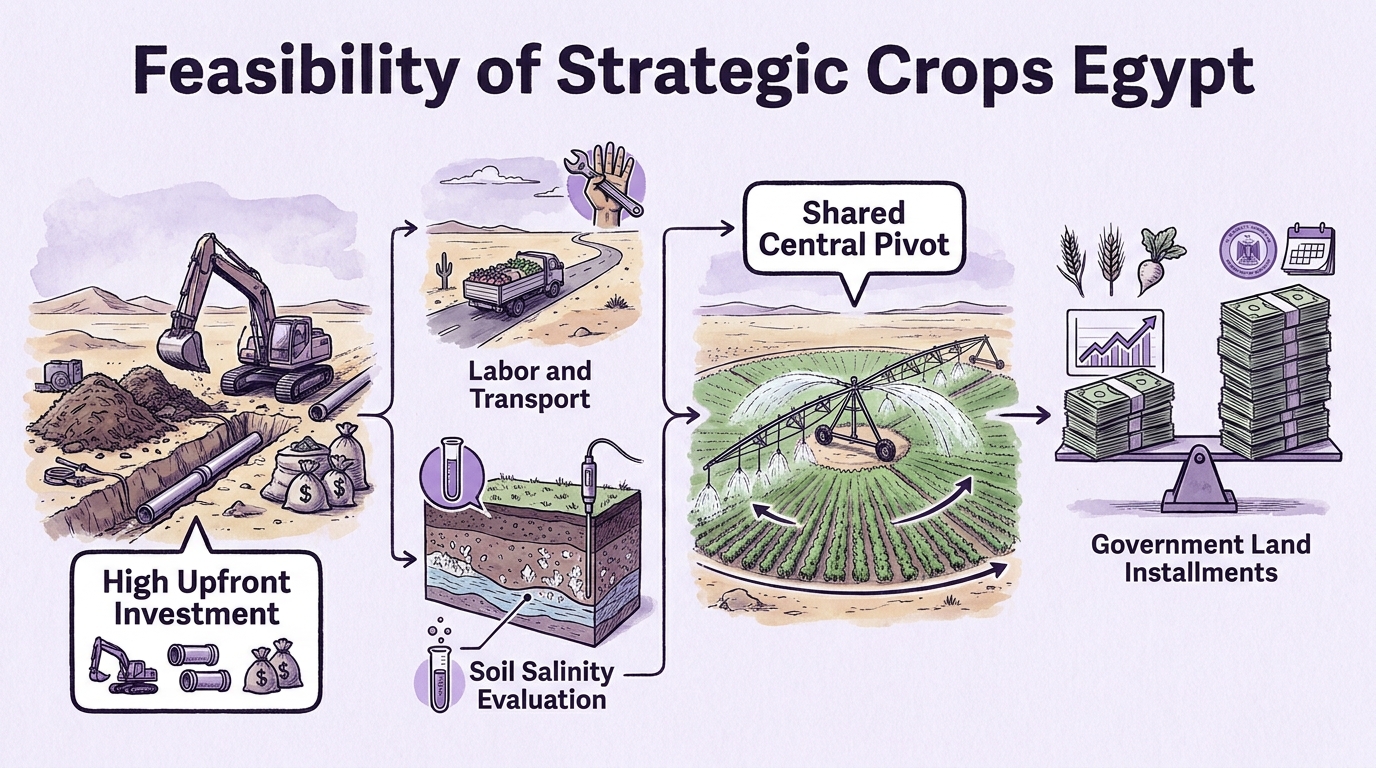
Agricultural expert Asaad El-Faqi evaluates the feasibility of planting strategic crops like wheat, barley, and sugar beets in the West-West Minya region of Egypt under the Egyptian Countryside Initiative. He details the high upfront investments required for irrigation, soil preparation, and labor in lands with high salinity and limited water resources. He concludes that relying solely on annual field crops without collective high-tech solutions like central pivots makes agricultural land reclamation financially unviable.

Key takeaways
- 3:15Prickly pear and traditional fruit crops face major harvest labor and transport marketing challenges in remote desert areas like West Minya
- 11:58Cultivating small acreage with seasonal crops like wheat or sugar beets fails to generate enough profit to cover high land installment fees
- 12:05Investing in shared central pivot irrigation systems (pivot) is essential for making field crop farming scalable and profitable in desert lands
Tap to enlarge
Most valuable section
For whom
Prospective land buyers and investors considering desert agriculture under the Egyptian Countryside project.
High Costs of Irrigation and Soil Preparation6:07
It breaks down the actual numbers for sprinkler systems, organic fertilizer, and seeds, illustrating why low-budget individual farming often fails.
Detailed summary
1. Introduction & Critique of High-Cost Crop Feasibility
0:00Asaad El-Faqi opens by addressing queries from Egyptian expatriates regarding land reclamation projects in West-West Minya. He notes that high-cost options like Medjool date palms require substantial capital of around 10 million EGP, prompting investors to look for cheaper alternatives with lower overhead.
He discusses prickly pear as a low-water alternative, but highlights severe constraints regarding skilled labor availability and high transport costs to central markets, which eat into profit margins.
2. Limitations of Prickly Pear and Sugar Beets in Remote Lands
3:15The speaker analyzes why prickly pear is impractical in distant regions like West Minya compared to areas near Cairo or Alexandria. The lack of nearby consumer markets and intensive labor requirements during harvest make large-scale production risky.
He also addresses sugar beet cultivation, explaining that small-scale plots using drip irrigation incur excessive labor costs when repeatedly installing and removing pipes for mechanization, leading to net financial losses.
3. High Costs of Irrigation and Soil Preparation
6:07El-Faqi presents a detailed financial breakdown for preparing a 40-feddan plot, where only 25 feddans can be cultivated due to water availability. Installing a basic sprinkler system for wheat or barley costs approximately 750,000 EGP.
Additional expenses include organic fertilizer costs of 400,000 EGP to remediate virgin desert soil, land leveling, road construction, and seed purchases, raising initial capital needs to over 1.35 million EGP before factoring in land payments.
4. The Solution: Shared Central Pivot Irrigation
12:05To overcome the inefficiencies of small plots, El-Faqi advises farmers to form partnerships with adjacent landowners to invest in central pivot irrigation systems. A shared pivot costing around 3 million EGP split among 4 partners significantly improves operational efficiency.
Using pivots allows year-round crop rotation of wheat, barley, and sugar beets with minimal manual labor, maximizing yield potential in saline soil conditions.
5. Financial Viability and Final Warnings
13:30The video concludes by comparing expected crop profits against annual government land installment fees. Net returns from basic field crops (around 600,000 to 750,000 EGP annually) are often insufficient to cover land installments, pump equipment, and living expenses.
El-Faqi urges investors to realistically evaluate soil salinity and water depth before committing funds, warning against taking on land contracts without an adequately capitalized, long-term strategic plan.
Questions this video answers
Is growing prickly pear recommended in West Minya?
While prickly pear tolerates salinity and drought well, it requires significant skilled labor for harvesting and entails heavy transportation costs to reach major markets like Cairo. These logistical hurdles significantly erode profits when farming far from urban centers.
Why is sugar beet farming challenging for small plots in desert lands?
Sugar beets grown on small plots suffer from high mechanization or manual labor costs required to repeatedly lay and remove irrigation networks. Without large-scale automated farming, the operational costs outweigh the returns.
What is the total estimated setup cost for planting wheat on 25 feddans?
Initial expenses reach over 1.35 to 1.5 million EGP, excluding land purchase installments and deep-well pumps. This includes costs for sprinkler irrigation networks, organic soil amendments, land leveling, seeds, and basic farm infrastructure.
What is the recommended solution to make desert grain farming profitable?
Farmers should pool resources with neighboring landowners to purchase shared central pivot irrigation systems. A shared pivot allows continuous cropping of wheat, barley, and sugar beets while dramatically reducing labor and irrigation labor costs.
Ask a follow-up Premium
About this summary
SumTube AI wrote this recap from the video's words and chapters. Credit and the original belong to قناة الزيتونة الزراعية (Your agricultural advisor).